Essential Controlled Substances
DEA Compliance, Recordkeeping, and Diversion Prevention in Veterinary Practice
Most veterinary professionals never receive formal training on controlled substance compliance — yet recordkeeping violations carry fines up to $15,000 per citation. In a 2018 Colorado survey, 44% of veterinarians were aware of opioid misuse by a client or staff member. This 2-hour program gives you clear, implementable protocols for recordkeeping, inventory management, and client diversion prevention — built from real scenarios Dr. Forsythe has encountered in practice.
Clinical Review Date: April 2026 • RACE #20-1322554 • Provider ID #50-29055
CE Hours
2.0 Medical CE
Format
Live Webinar
Price
$85 (Standard)
Audience
DVMs & Technicians
Species
Canine & Feline
Status
RACE-Approved
Tuesday, April 7, 2026
Watch the recording and earn CE credit at your own pace.
Practical Takeaways for Your Practice
Every session is built around cases you see in GP — leave with frameworks you can apply immediately.
DEA Recordkeeping Compliance
A clear framework for maintaining complete, accurate controlled substance records — understand what the DEA evaluates during an inspection, how to run a running inventory like a checkbook, and how to separate C2 from C3–C5 logs correctly. If the DEA shows up and your numbers don't match, fines hit $15,000 per citation.
Inventory Auditing & Discrepancy Response
Practical protocols for biennial inventory, cycle counts, and reconciliation — plus the exact steps when numbers don't match, including the 24-hour DEA notification and Form 106 submission within 45 days. Dr. Forsythe walks through what happens when you find a discrepancy before vs. after the DEA does.
Client Diversion Red Flags
How to recognize drug-seeking behavior — the client demanding early hydrocodone refills, the officer whose tramadol "went down the sink," the new client requesting gabapentin by name. Includes vet shopping (93% of surveyed vets have heard of it, 57% encountered it), refill window policies, and staff communication protocols.
Electronic vs. Paper Systems
An honest comparison of electronic drug logging platforms versus paper logs — password-verified entries, tamper resistance, numbered pages that reveal missing records, and how to choose the system that fits your practice size and workflow.
Course Abstract
Live Online Interactive Webinar • Case-Based • Sponsor-Free
A police officer calls — his K9's tramadol "accidentally dumped down the sink." A client demands early hydrocodone refills every month for a dog with collapsing trachea. An unfamiliar 20-something walks in with a dog with a severe cut, asking for pain meds. None of these have a clear answer — and that's exactly why this course exists.
Over two focused sessions, Dr. Lauren Forsythe walks through the practical "what, why, and how" of controlled drug documentation and client diversion prevention. From understanding the DEA's closed-system tracking model to recognizing drug-seeking behavior at the front desk, this course equips you with knowledge and tools you can put to work the next morning. You'll work through real cases where the line between legitimate need and diversion isn't obvious — and learn defensible protocols for each.
Curriculum Overview
Two focused lectures totaling 2.0 RACE-approved CE hours.
01. Recordkeeping: Do You Know Where Your Controlled Drugs Are?
1.0 HourThe DEA's closed-system model and why your in-practice tracking must match it. Federal recordkeeping requirements, electronic vs. paper log systems, inventory formats, biennial inventory obligations, and how to audit your own records before the DEA does it for you. Includes real-world scenarios: what happens when the numbers don't add up, how new technicians introduce errors, and when to file Form 106.
- Explain why controlled substance recordkeeping must be a priority
- Identify recordkeeping strategies that fit your specific practice setting
- List pros and cons of electronic and paper drug logs
- Describe how to audit controlled drug records for accuracy and completeness
02. Preventing Client Drug Diversion
1.0 HourClient-side diversion is where most risk begins. Dr. Forsythe walks through cases from her own practice: the hydrocodone client who called every month demanding early refills, the K9 officer whose tramadol "went down the sink," the unfamiliar client with a severely injured dog asking for pain meds. You'll learn to recognize vet shopping (93% of surveyed vets have encountered it), understand PDMPs and their 75% reduction in doctor shopping, evaluate dispensing vs. prescribing trade-offs, and apply the corresponding responsibility doctrine.
- Summarize how to recognize drug-seeking clients
- Describe PDMP technology and its limitations in veterinary medicine
- List reasons why prescribing vs. in-house dispensing may be beneficial
- Apply the corresponding responsibility doctrine in practice decisions
What's Included
Live Q&A
Ask questions in real time
Digital Notes
Downloadable lecture PDFs
Recording Access
Re-watch at your own pace
CE Certificate
RACE-approved, instant download
Clinical Resources
Downloadable guides and lecture notes to reinforce your learning and apply in practice.
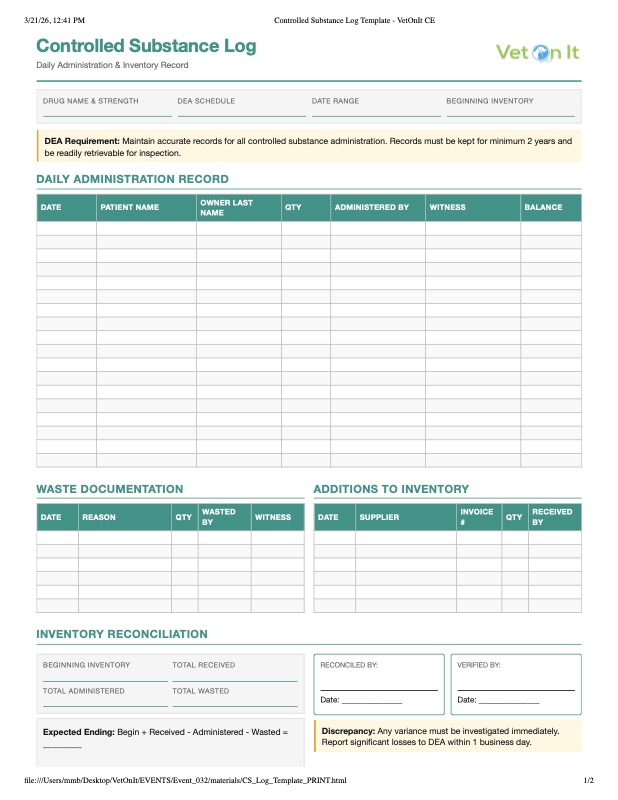
Controlled Substance Log Template
Printable daily administration record with waste documentation, inventory receiving, and reconciliation — ready to use in practice.
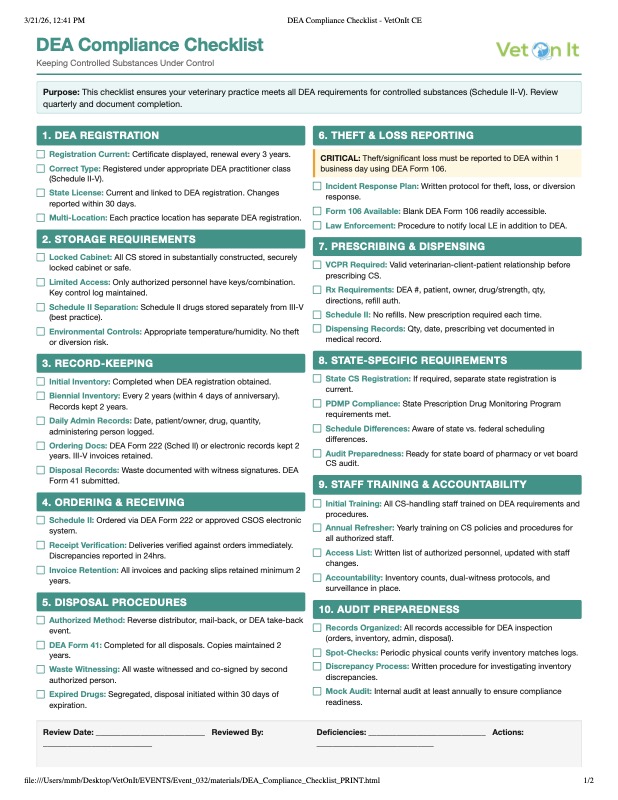
Get on-demand accessDEA Compliance Checklist
10-section quarterly compliance checklist: registration, storage, recordkeeping, ordering, disposal, and audit preparedness.
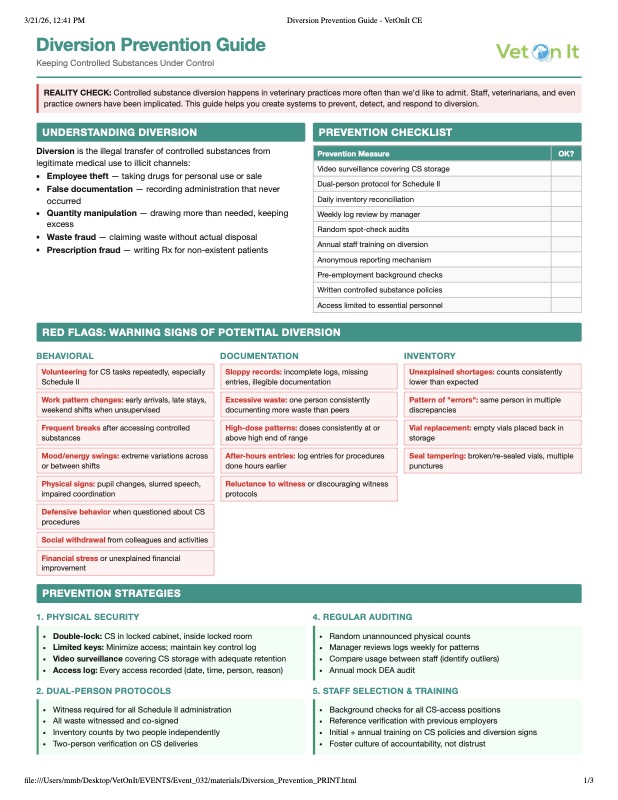
Get on-demand accessDiversion Prevention Guide
Behavioral, documentation, and inventory red flags plus dual-person protocols, investigation steps, and mandatory reporting.
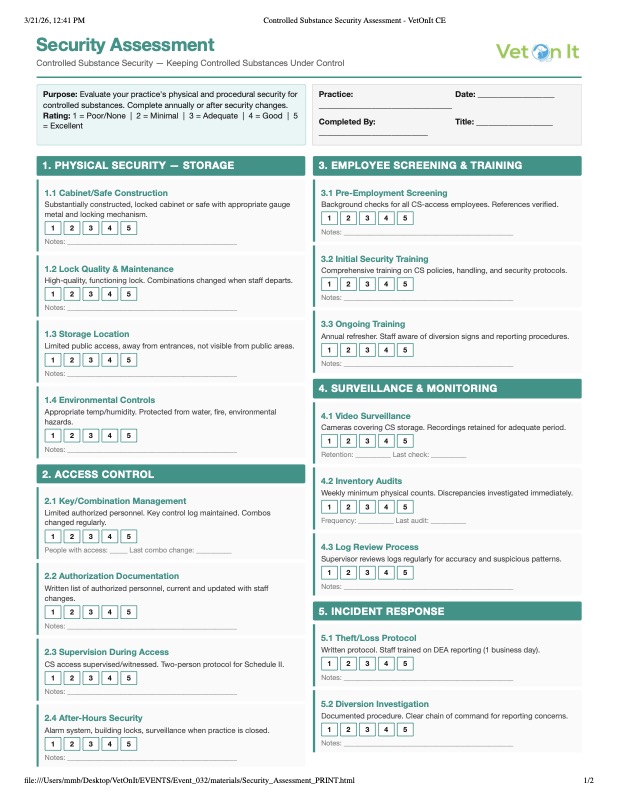
Get on-demand accessSecurity Assessment Tool
Scored 85-point assessment for physical security, access control, surveillance, training, and incident response.
Get on-demand accessAvailable for download immediately after registration in your Course Viewer.

Dr. Lauren Forsythe, DVM
Assistant Professor, College of Pharmacy — University of Findlay | Founder, Foresight Pharmaceutions
Dr. Lauren Forsythe earned her PharmD from the University of Findlay and completed a veterinary pharmacy residency at Purdue's Veterinary Teaching Hospital. She is a Diplomat of the International College of Veterinary Pharmacists (DICVP) and teaches pharmacy law and controlled substance management at the University of Findlay College of Pharmacy. After seeing how veterinary graduates were sent into practice without formal controlled substance training, she founded Foresight Pharmaceutions to help practices build legally compliant processes. She previously ran the pharmacy at the University of Illinois College of Veterinary Medicine and completed her MBA during that time.
View Full Faculty BioDoes Your State Require Controlled Substance CE?
Eight states mandate controlled substance or opioid CE for veterinarians. This 2-hour course fully meets or exceeds the requirement in 7 of them.
Arizona
3 hrs / cycle (2 of 3 hrs)
Texas
2 hrs / 2 years
North Carolina
2 hrs / cycle
Oklahoma
2 hrs + 1 hr opioid
Michigan
1 hr + 3 hr one-time
Tennessee
2 hrs / cycle
New Jersey
1 hr / cycle
Colorado
1 hr / cycle
Alabama and Florida have adjacent pharmacy/drug dispensing CE requirements that this course also addresses. Veterinarians are exempt from the federal 8-hour opioid training mandate (2023 Consolidated Appropriations Act) — but these state-level requirements still apply.
Frequently Asked Questions
Ready to Get Your Controlled Substance Compliance in Order?
All tiers include 2.0 RACE-approved CE credits, digital notes, and recording access.
If your schedule changes, you'll still have access to the recording and notes.
Standard
- 2.0 Hours Live RACE-Approved CE
- Interactive Q&A with Dr. Lauren Forsythe
- Digital Lecture Notes (PDF)
- Session Recording Access
- Official CE Certificate
Watch the Recording. Earn Your CE.
This lecture is now available on-demand. Watch Dr. Lauren Forsythe's full 2.0-hour presentation at your own pace and earn RACE-approved CE credit.